↗
01
Portable
A compact architecture intended to reduce dependence on a fixed bench setup for early-stage testing and demonstrations.
A compact electrospinning platform built to move nanofiber prototyping out of the fixed lab setup and into a more portable, flexible workflow — now presented with the new Gigoplet identity and the real device visual for the 2027 launch.
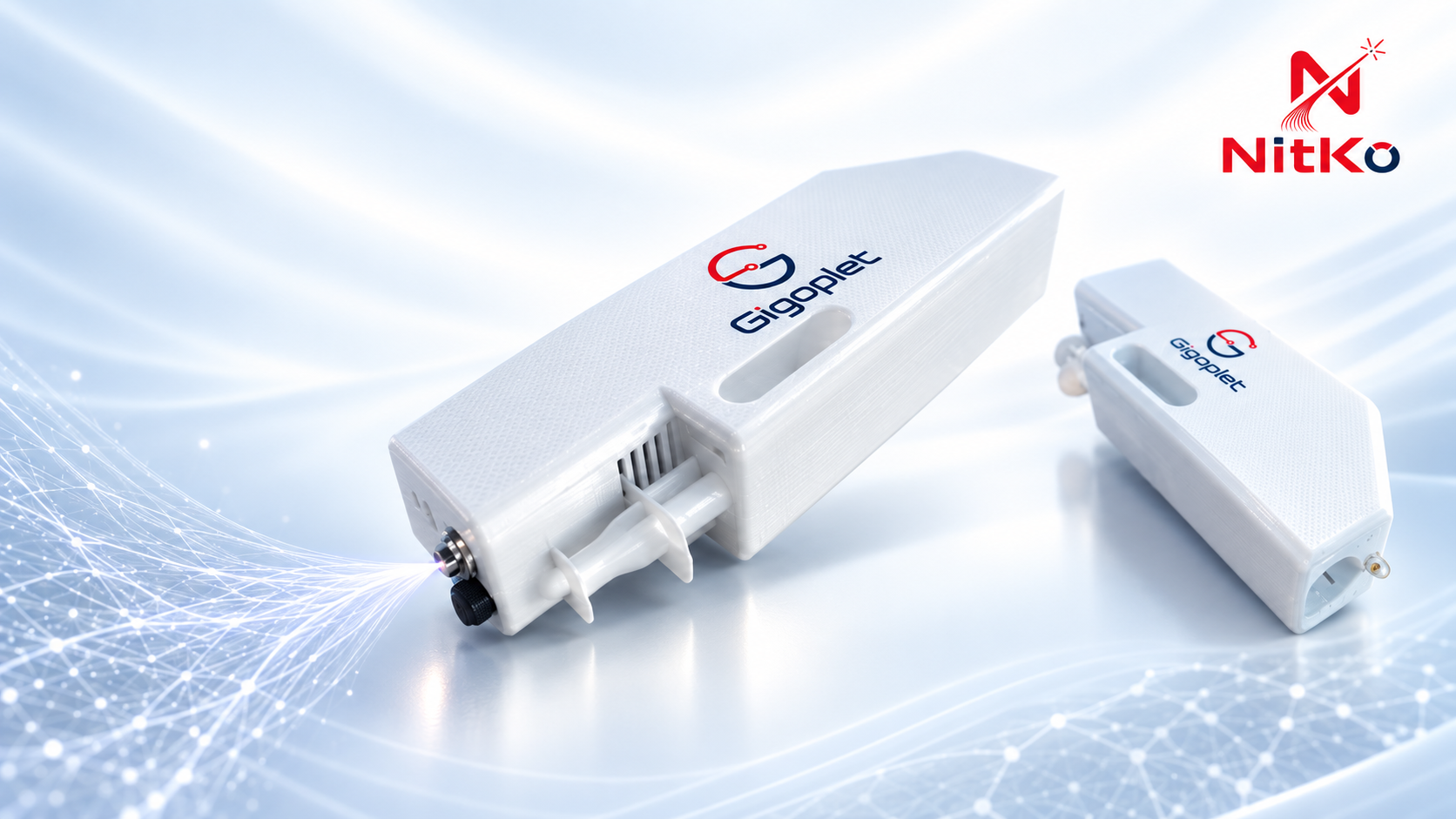
Gigoplet keeps the core logic of electrospinning while rethinking the physical format around mobility, iteration and practical experimentation.
A compact architecture intended to reduce dependence on a fixed bench setup for early-stage testing and demonstrations.
Create fibers directly onto selected collectors or surfaces, supporting faster exploration of form, coverage and substrate interaction.
Designed for iterative development around solutions, collectors, electronics and application-specific configurations.
Shorten the loop between formulation, electrospinning, observation and the next experimental iteration.
Electrospinning uses a strong electric field to draw a polymer solution into extremely fine fibers. Gigoplet packages that principle into a compact, purpose-built format.
Choose a compatible polymer formulation and load the working solution for your experiment.
The electrospinning system establishes the electric field that initiates and stretches the polymer jet.
As the jet travels, solvent evaporates and the material is drawn into ultrafine fibers.
Collect fibers on the selected target, evaluate the result and refine the next experimental run.
Hands-on electrospinning demonstrations, method development and laboratory exploration.
Experimental fiber layers, functional surfaces and new substrate combinations.
Prototype fibrous structures where high surface area and fine fiber diameter matter.
Use the platform as a base for new collectors, formulations and application-specific research.
Research-led. Hardware-first. Built in Croatia.
Gigoplet is developed by NitKo, a Croatian R&D venture focused on compact electrospinning, nanofiber systems, materials and device engineering.
The project began as NanoWeaver with a simple question: why should electrospinning be tied to a large, fixed laboratory setup? We are developing a smaller, more portable platform that keeps the core electrospinning process while making experimentation, demonstrations and early-stage product development more flexible.
Our work combines materials science, textile technology, electronics, 3D-printed components and iterative prototyping. In 2027, NanoWeaver becomes Gigoplet — the next generation of the project and the brand we intend to take to market.
Gigoplet is being developed by a small multidisciplinary team working across electrospinning, materials, prototyping, testing and product development, while acknowledging the people who shaped the project from the beginning.
Textile technologist and electrospinning researcher working at the intersection of nanofibers, polymers, technical textiles and product development.
Onjegin helped shape the early development of the device and remains an important part of the Gigoplet story, its technical direction and the team behind it.
Contributes to Gigoplet's product development, experimental work and the iterative process of turning the concept into a robust working device.
Supports prototyping, testing and development as the team refines the platform for repeatable use and a production-ready 2027 version.
We build, test, learn and rebuild — combining scientific development with practical engineering until the device is ready to leave the prototype stage.
The NanoWeaver project is transitioning into Gigoplet, with the product, brand and launch plan aligned around a 2027 commercial release.
Finalize the production-oriented architecture, electronics, enclosure and safety-oriented design refinements.
Run controlled beta use, collect feedback and verify repeatable setup, handling and performance.
Open early-access ordering while preparing small-batch manufacturing, documentation and fulfillment.
Launch Gigoplet publicly and begin first commercial deliveries to early users.
Join the early-access list for development updates, beta opportunities and the 2027 launch.